
“Most of us, most of the time, change very gradually, bit by bit, day by day. But it also can and does happen sometimes that people are transformed suddenly and permanently by a highly memorable experience… It was like passing through a one-way door.” – William R. Miller
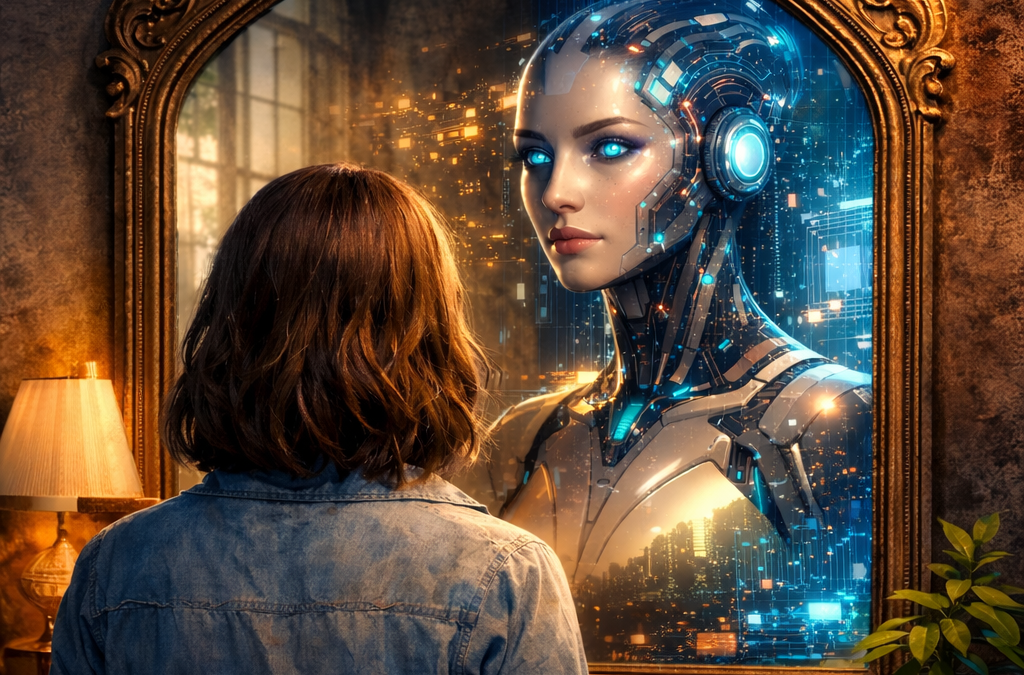
“Mirror, mirror on the wall…” is the Evil Queen’s daily ritual in Snow White—and it’s not a neutral question. It’s a dependency. She doesn’t consult the mirror for truth; she consults it for narcotic reassurance (or an enemy to destroy).
The mirror becomes her outsourced self-worth, and eventually, her undoing.
That’s the psychological risk with AI, too: not that it “lies” in some cartoon-villain way, but that it can become the mirror we binge—a perfectly responsive surface that keeps feeding the mood, story, and assumptions we bring to it.
In other words, if we don’t examine which mirror we’re looking into, AI will happily polish our preferred and possibly unconscious narrative until it shines.
There is a truth in the phrase —“No problem can be solved from the same level of consciousness that created it.” When we use AI as a shortcut, we risk reproducing the same thinking patterns at a faster pace. Large language models are extraordinarily good at reflecting our framing at us. That can look like “help,” but it can also be confirmation bias or unconscious lens dressed up as insight.
So what does it take to use AI to expand consciousness rather than shrink it?
First: discernment must become a spiritual practice. The key isn’t getting answers; it’s keeping the human being connected to inner guidance so we don’t become “spiritually lazy” and outsource the work of listening inward. The best sequence is often: sense first, then consult AI to widen your view—not to replace your center.
Second: we need to meet the mirror with better questions than our ego would ask. When the interaction becomes purely transactional (“tell me what I want to hear”), the output tends to reinforce existing identity. When it becomes inquiry (“show me what I’m not seeing”), something else can happen: the conversation turns into a reflective container—more like Socratic dialogue than fortune-telling. AI ultimately prompts us to ask: What is uniquely human?
Third: we have to decide who we’re becoming while we use it. If we approach AI as a narcissistic mirror, we train ourselves toward dependence. If we approach it as a disciplined reflective instrument, we can use it to build soul: more interiority, more meaning, more capacity to see symbolically and hold complexity. That’s “soul-making” in practice—letting the world (and now, our tools) become a vehicle for deepening our inner life.
Here’s the simple test: After an AI session, do you feel more inflated, more certain, more hooked—or more honest, more curious, more responsible?
AI can be a mirror that traps us like the Evil Queen, or a mirror that sobers us into becoming more fully human. The difference isn’t the machine. It’s the consciousness we bring to the gaze.
Have you found value here? Have you been inspired or moved? Please consider sharing the post on your social media networks by using the buttons below.
I love to hear your comments and ideas. Use the comments below or send me an email.
Is this your first time here? Does your soul need feeding? Are you looking for a Jungian based inspirational reflection to help with life's challenges. The Jungian Path Newsletter is a monthly reflection on the theme of the new moon. Join the list today.